
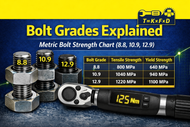
Bolt Grades Explained | Metric Bolt Strength Chart 4.6, 8.8, 10.9, 12.9
12th Mar 2026
Bolt Grades Explained: Metric Bolt Strength Chart (8.8, 10.9, 12.9)
What Are Bolt Grades?
Bolt grades indicate the mechanical strength of a fastener, helping engineers and installers determine how much load a bolt can withstand before deforming or failing.
Metric bolts use a two-number strength classification system, such as:
These numbers represent the bolt’s tensile strength and yield strength, measured in megapascals (MPa).
Understanding bolt grades is critical when designing or assembling:
-
structural steel connections
-
heavy machinery
-
construction equipment
-
mining equipment
-
automotive assemblies
Selecting the correct bolt grade ensures the fastener provides sufficient clamping force and structural reliability.
Metric Bolt Grades Chart
| Bolt Grade | Tensile Strength | Yield Strength | Typical Use |
|---|---|---|---|
| 4.6 | 400 MPa | 240 MPa | light-duty assemblies |
| 8.8 | 800 MPa | 640 MPa | machinery & fabrication |
| 10.9 | 1040 MPa | 940 MPa | heavy equipment |
| 12.9 | 1220 MPa | 1100 MPa | high-load mechanical systems |
Higher numbers indicate greater bolt strength and load capacity.
How Metric Bolt Grades Are Calculated
Metric bolt grades follow a standard formula used internationally in engineering.
R_m = a \times 100
Where:
-
Rₘ = tensile strength (MPa)
-
a = first number in the bolt grade
Example:
Grade 8.8
Yield strength is calculated as:
Example:
Metric Bolt Grades Explained
Grade 4.6 Bolts
Grade 4.6 bolts are low-strength fasteners used for light-duty applications.
Common uses:
-
furniture
-
light brackets
-
sheet metal assemblies
-
non-structural applications
These bolts are typically made from mild carbon steel.
Grade 8.8 Bolts (High Tensile)
Grade 8.8 bolts are the most common high tensile bolts used in construction and industrial applications.
They provide a strong balance of strength, durability and cost efficiency.
Typical applications:
-
steel fabrication
-
industrial machinery
-
construction assemblies
-
automotive components
Many hex bolts and structural bolts are manufactured in this grade.
Grade 10.9 Bolts
Grade 10.9 bolts are high-strength alloy steel fasteners designed for demanding mechanical environments.
Common uses include:
-
mining equipment
-
heavy machinery
-
structural connections
-
industrial plant equipment
They offer significantly higher load capacity than Grade 8.8 bolts.
Grade 12.9 Bolts
Grade 12.9 bolts are ultra high-strength fasteners used in precision engineering.
Typical applications include:
-
heavy mechanical systems
-
tooling and dies
-
high-performance machinery
-
industrial drives
These bolts are extremely strong but may also be more brittle, requiring careful installation.
Bolt Head Markings Explained
Metric bolts typically have their strength class stamped on the head.
Common markings include:
10.9
12.9
These markings help installers confirm the correct fastener grade during assembly or maintenance.
If no grade marking is visible, the bolt may be low-strength or non-standard.
Bolt Grades vs Bolt Materials
Bolt strength is influenced by both material composition and heat treatment.
Common bolt materials include:
Carbon Steel Bolts
Used for most industrial fasteners.
Alloy Steel Bolts
Used for high tensile grades such as 10.9 and 12.9.
Stainless Steel Bolts
Offer superior corrosion resistance but typically lower strength.
Material selection depends on:
-
load requirements
-
corrosion exposure
-
engineering standards
Bolt Grades and Torque Requirements
Higher strength bolts require greater tightening torque to achieve the correct clamping force.
Incorrect torque can cause:
-
joint loosening
-
bolt fatigue
-
structural failure
Refer to our Metric Bolt Torque Chart for recommended tightening values.
Choosing the Correct Bolt Grade
When selecting a bolt grade, engineers should consider:
Load Capacity
Higher loads require stronger bolts.
Safety Factors
Structural connections require appropriate safety margins.
Environmental Conditions
Outdoor applications may require corrosion resistant coatings.
Industry Standards
Engineering specifications often define minimum bolt grades.
Frequently Asked Questions
What is the strongest metric bolt grade?
Grade 12.9 is one of the strongest commonly used metric bolt grades.
What does 8.8 mean on a bolt?
The marking 8.8 indicates:
-
tensile strength = 800 MPa
-
yield strength = 640 MPa
Is a 10.9 bolt stronger than 8.8?
Yes. Grade 10.9 bolts are significantly stronger and designed for higher load applications.
Are higher grade bolts always better?
Not necessarily. Higher strength bolts may be more brittle and require precise torque settings.
Shop High Tensile Bolts
Konnect Fastening Systems supplies a comprehensive range of industrial fasteners and high tensile bolts, including:
All products meet relevant engineering standards and are suitable for construction, fabrication and industrial applications.