
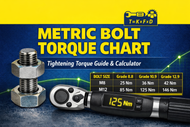
Metric Bolt Torque Chart (Complete Guide for Metric Fasteners) and Bolt Torque Calculator
12th Mar 2026
Metric Bolt Torque Chart – Quick Reference and Bolt Torque Calculator
Correct bolt torque is essential to ensure fasteners achieve the proper clamping force without overstressing the bolt or damaging the joint. Under-tightening can lead to joint loosening and fatigue failure, while over-tightening may stretch or fracture the fastener.
The chart below provides typical tightening torque values for common metric bolt sizes and strength grades, including Grade 8.8, 10.9 and 12.9 fasteners.
These torque values are widely used in mechanical engineering, fabrication, construction and industrial maintenance applications.
Metric Bolt Torque Chart (Dry Assembly)
| Bolt Size | Grade 8.8 Torque | Grade 10.9 Torque | Grade 12.9 Torque |
|---|---|---|---|
| M6 | 10 Nm | 15 Nm | 17 Nm |
| M8 | 25 Nm | 36 Nm | 42 Nm |
| M10 | 49 Nm | 72 Nm | 84 Nm |
| M12 | 85 Nm | 125 Nm | 146 Nm |
| M16 | 210 Nm | 310 Nm | 360 Nm |
| M20 | 410 Nm | 600 Nm | 700 Nm |
| M24 | 710 Nm | 1040 Nm | 1220 Nm |
Values are indicative for dry threads and standard pitch fasteners.
Why Correct Bolt Torque Matters
When tightening a bolt, the torque applied generates tension within the fastener, creating clamping force between the jointed materials.
Correct torque ensures:
-
Proper joint preload
-
Resistance to vibration loosening
-
Even load distribution
-
Reduced risk of fatigue failure
Incorrect torque can lead to:
-
bolt stretching or failure
-
joint movement
-
gasket leakage
-
structural failure
For critical applications, torque values should always follow engineering specifications or manufacturer recommendations.
Common Metric Bolt Grades Explained
Metric bolts are typically manufactured in several strength classes. The most common include:
Grade 8.8
Medium-strength structural fastener commonly used in machinery and construction.
Typical applications:
-
equipment assemblies
-
steel structures
-
automotive components
Grade 10.9
High-strength fasteners used where increased load capacity is required.
Typical applications:
-
heavy machinery
-
structural steel
-
industrial equipment
Grade 12.9
Very high-strength fasteners typically used in precision machinery and high-load mechanical assemblies.
Typical applications:
-
tooling
-
mechanical drives
-
heavy industrial equipment
Understanding the bolt grade is essential because torque values increase significantly with bolt strength.
Factors That Affect Bolt Torque
Several variables influence the torque required to achieve proper clamping force.
Lubrication
Lubricated threads reduce friction and may require 20–30% lower torque compared with dry threads.
Thread Condition
Damaged or dirty threads increase friction and may prevent proper preload.
Surface Finish
Coatings such as:
-
zinc plating
-
galvanising
-
black oxide
can change friction characteristics.
Washer Use
Using hardened washers can improve load distribution and produce more consistent torque results.
Example: Torque for an M12 Bolt
One of the most commonly used industrial fasteners is the M12 bolt.
Typical torque values:
-
M12 Grade 8.8 → ~85 Nm
-
M12 Grade 10.9 → ~125 Nm
-
M12 Grade 12.9 → ~146 Nm
These values apply to standard pitch bolts in dry conditions.
Metric Bolt Sizes and Applications
Metric bolts are widely used across industries including:
-
construction
-
mining
-
manufacturing
-
automotive
-
engineering
Common bolt sizes include:
| Bolt Size | Typical Applications |
|---|---|
| M6–M8 | light assemblies, machinery covers |
| M10–M12 | equipment frames, fabrication |
| M16–M20 | structural connections |
| M24+ | heavy structural and industrial applications |
Shop Metric Bolts and Fasteners
Konnect Fastening Systems supplies a comprehensive range of metric fasteners for industrial and construction applications, including:
All products are sourced from trusted global manufacturers and meet relevant engineering standards.
Explore our full range of industrial fasteners on the Konnect website.
Frequently Asked Questions
What torque should I use for metric bolts?
Torque depends on bolt size, strength grade, thread pitch and lubrication conditions. Always refer to an appropriate torque chart or engineering specification.
Does lubrication change torque values?
Yes. Lubricated threads reduce friction and typically require lower tightening torque to achieve the same preload.
What happens if a bolt is over-torqued?
Over-tightening may stretch the bolt beyond its elastic limit, weakening the fastener or causing sudden failure.
Bolt Torque Calculator
Select your bolt size and thread condition to estimate recommended torque.